Masahiro Funabashi*, Masao Kunioka
Research Institute for Innovation in Sustainable Chemistry
National Institute of Advanced Industrial Science and Technology
Higashi 1-1-1, Tsukuba, Ibaraki 305-8565, Japan
Fax (+81) (0)29-861-4589; E-mail:
Abstract: Biodegradable polymer composites consisting of poly(lactic acid) (PLA) and cellulose fibers (CF) were prepared by our newly developed method. L-Lactic acid (LA) was reacted by ring-opening polymerization with aluminum triflate as a catalyst, glycerol as an initiator and CF as a filler in simple plastic tubes at 100℃ for 6 hours. By this method, CF could be mixed to polymer matrix easily and homogeneously. The molecular weight and molecular weight distribution of PLA matrix were determined by gel permeation chromatography (GPC). Mn of composite samples decreased from 6200 to 2800 with increasing CF content. The molecular weight distribution of composites was around 2.5 regardless of the CF content. Biodegradation of samples was determined by measuring Microbial Oxidative Degradation Analyzer (MODA) and the weight loss in compost. Biodegradation of composite samples of PLA with CF increases with increasing CF content by MODA. Apparent density of composite samples was calculated by using weight and sizes of column shape specimens. Density of composite samples is a bit lower than that of PLA pure sample without CF. The mechanical properties such as elastic modulus and strength were investigated by compression tests using column shape specimens. For the sample with filter paper as CF, the strength of composite samples increases with increasing CF content.
Introduction
Polymer composites are widely used in various industrial fields due to their good physical properties such as high specific strength, high specific modulus, chemical resistance, etc. However, some of these properties create difficulties in disposal after use. One solution to the above problem is the development of biodegradable polymer composites. Such composites can be designed by combining biodegradable matrices and biodegradable fillers. The above composites have the same benefits as ordinary polymer composites and are also to dispose of easy after use. For actual use, these polymer composites are required to have comparable mechanical properties to those of ordinary polymer composites. Research on biodegradable composites filled withcellulose fibers in order to improve the mechanical properties has been carried out. In this study, the improvement of mechanical properties and control of the biodegradability of poly(lactic acid) (PLA) are investigated by combining cellulose fibers (CF) and PLA.
In our laboratory, poly(caprolactone) (PCL) could be synthesized by ring-opening polymerization from caprolactone using yttrium triflate as a catalyst under air in open glassware.1-2 PCL composite with cellulose fiber has been prepared by mixing fibers and monomer liquid with yttrium triflate as a catalyst before polymerization and heating at 60℃ for 48 hours.3 In general, composites with cellulose fiber were prepared by powerfully mixing matrix and fiber above melting temperature in an extruder. By our method, mixing fillers and monomer liquid with low viscosity saves energy at lower temperatures. For example, we have prepared PCL composite with cellulose fibers at around melting temperature (60℃). In addition, PLA could be polymerized from LA by aluminum triflate. We found this system could be applied to the preparation of PLA composites with cellulose fibers at 100 ℃ for 6 hours.
In this study, CF was combined with PLA matrices in order to achieve improvements in mechanical properties and control of the biodegradability. The effects of the type and content of fibers on the mechanical properties were investigated. The effect of existence of cellulose fibers on the biodegradability was also investigated.
Experimental
Materials
L-Lactide (LA, (3S, 6S)-cis-3,6-dimethyl-1,4-dioxane-2,5-dione, Tokyo Kasei, Japan), and aluminum triflate (trifluoromethanesulfonate, Al(OTf)3) (Aldrich) were used as received after drying. Two kinds of cellulose fillers (CF) were used as fillers for composite samples. That is, CF from filter paper (CFP, Ashless pulp, Tokyo Roshi Kaisha, Ltd.) and absorbent cotton (CFC, Iwatsuki Co.).
Sample preparation
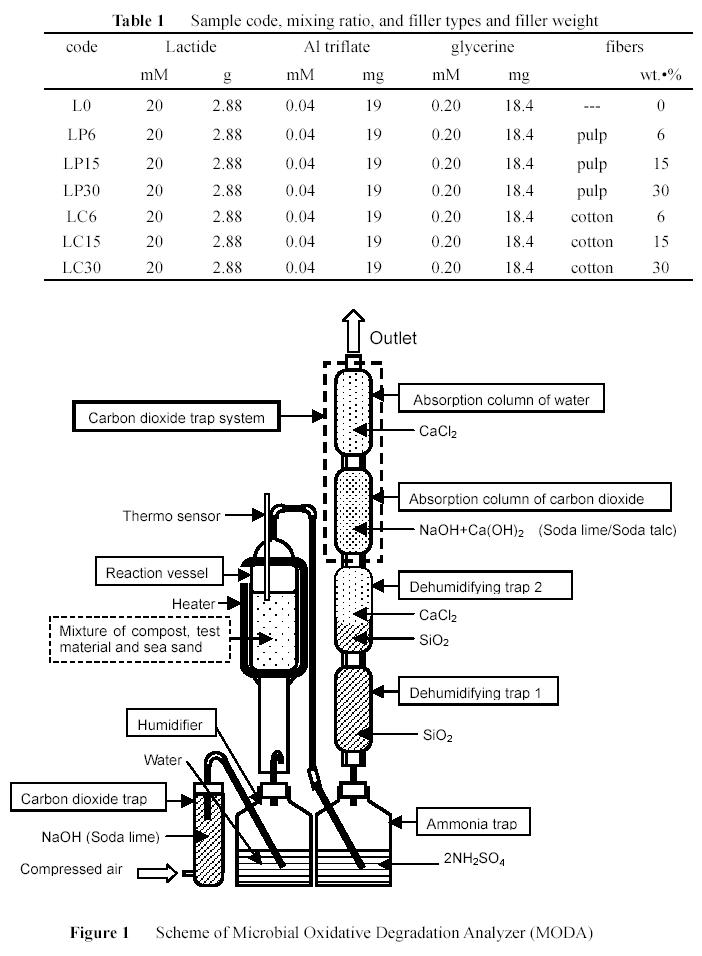
PLA composites were prepared by the following procedure as shown in Figure 1. LA and Al triflate were dried in a vacuum oven at room temperature for 12 hours. CFP and CFC were dried in a vacuum oven at 115 oC for 12 hours. LA (20 mM, 2.8 g), glycerin as an initiator (0.02 mM, 18.4 mg) and Al triflate as a catalyst (0.04 mM, 19.0 mg) were mixed in air after melting at 100 oC. The mixture of ca. 3 g was poured into plastic tubes which were filled with cellulose fibers. The amount of CF was varied from 0 to 1.0 g. A plastic tube was placed in an incubator at 100℃ without stirring for 6 hours. The solid samples were removed from the plastic tubes after cooling to room temperature. Composite samples were cut into column shaped specimens for the mechanical tests. The sample codes, mixing ratios in mole and in weight, filler types and filler weights are shown in Table 1.
Molecular weight measurements
The molecular weight and molecular weight distribution were determined by gel permeation chromatography (GPC) using a Tosoh 8000 GPC system with a refractiveindex detector. A combination of two TSK GMHXL columns (Tosoh, Japan, 7.8 mm x 30 cm) with molecular weight ranges of 1000 – 1 x 10⁷ g•mol-1 was used. The columns were eluted by chloroform (flow rate of 1 mL min-1 at 40 oC) and calibrated with polystyrene standards.
Biodegradability measurements
The biodegradability of samples was measured by two methods. One is the weight change of samples in the compost at 58 oC. Plate specimens (ca. 0.25 g) with about 12 mm diameter and 2 mm thickness were cut from the samples and put into plastic bottles (500 ml) with compost (80 g). The bottles were placed in an electric oven at 58 oC. The plate specimens were removed and washed in deionized water. The compost used in these experiments were mature compost made from used wood sponge for growing mushroom and chicken droppings under controlling condition. The weight of specimens was measured after removing water on the surface of the specimen by filter paper gently. The other method is gravimetric measurement of carbon dioxide of samples under controlled composting conditions by using MODA (Microbial Oxidative Degradation Analyzer, Hissan Trading Company Limited). The scheme of the MODA is shown in Figure 1. The samples (ca. 10 g) were cut and mixed with compost (ca. 80 g) and sea sand (ca. 320 g), and the mixture was put into a reaction vessel. The compost including sample in the reaction vessel was aerated air gas after trapping CO2 and controlling humidity as shown in the figure. CO2 gas in the evolved gas from the reaction vessel was trapped by upper two columns after dehumidifying lower two columns. The upper two columns of the absorption column of carbon dioxide and the abruption column of water were weighed everyday. In addition, the production amount of CO2 from the compost without sample was measured as blank in the same manner. The biodegradability was determined by dividing the difference between produced CO2 amount subtracting CO2 amount from the blank by theoretical produced CO2 amount for each sample. Once a week, the compost including sample was controlled the water content and mixed well after taking out from the reaction vessel.
Mechanical tests
The mechanical properties were determined by compression tests using a Shimadzu Autograph AG-10TB with column shaped specimens that were the same as those used for the density measurements. Test speed was 0.1 mm/min. The strength and elastic modulus were investigated as the mechanical properties of samples. The strength of samples was determined as a maximum stress from the stress-strain curve. The elastic modulus was determined as a gradient of the initial linear part of stress-strain curve. The averages of strength and modulus were obtained using three specimens for each measurement.
Results and discussion
Molecular weight
PLA composite samples were prepared by the simple method under air using Al triflate as a catalyst at 100 oC for 6 hours indicated in Experimental. The filler content, the molecular weight, Mn, and molecular weight distribution, Mw/Mn, by GPC measurements are shown in Table 2. Mn for L6 is 6400 and is almost the same value as 6200 for L0 sample. The values of Mw/Mn are around 2.5 regardless of the fiber content. The existence of fibers creates a decrease in the molecular weight. In this way, it was found that PLA composite could be produced from LA and CFC using Al triflate by simple method at 100 oC for 6 hours. The obtained values for samples of L15 and L30 are 4600 and 2800, respectively. These results were relatively lower than that for sample of L0.
Biodegradability
Biodegradability of samples was investigated by two different methods. That is, the weight loss in the compost and Microbial Oxidative Degradation Analyzer (MODA). The weight changes of the plate sample in the compost at 58 oC are shown in Figure 2. Weight changes of samples except for blank (L0) and PLA composite with smallest CF (LP6) increase with increasing time until 21 days. The samples with greater fiber content, such as LP10 and LC10, shows higher weight change than those of the samples with smaller fiber content, such as LP5 and LC5. It is thought that weights of samples increase below 21 days since the fibers of filter paper or cotton in the samples absorbed water. The weight changes of samples after 21 days monotonously decrease with increasing time. The weight decrease of samples of LP5 and LC5 are greater than those of other samples. The weight changes of other samples show almost the same values. The water absorbance of samples is observed in the initial stage by this method. It is difficult to determine the accurate value of biodegradability for the samples having high water absorbance by this method.
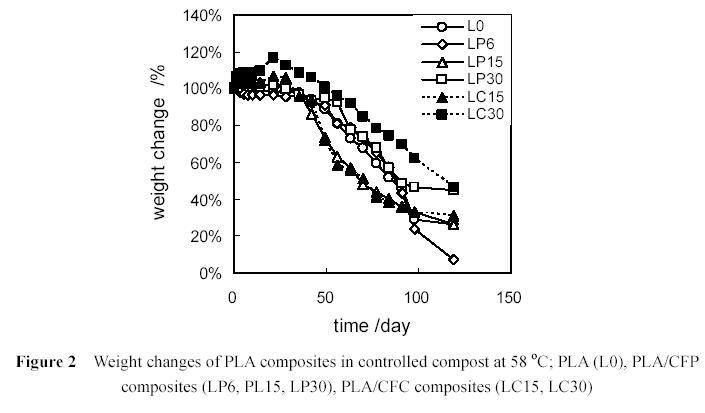
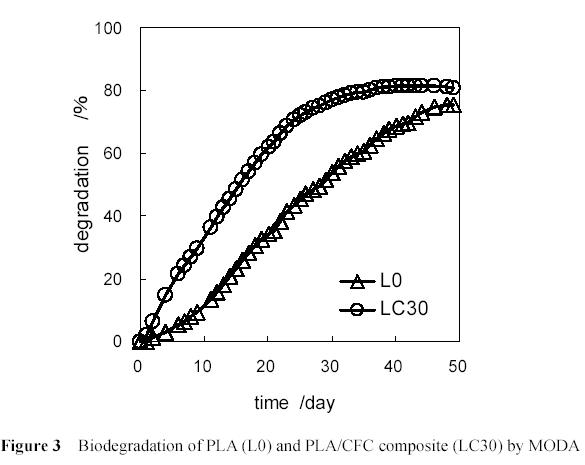
In order to determine the accurate biodegradation speed of PLA and PLA/CFC composites except the amounts of absorbed water in composite at 58 oC, the production amounts of CO2 from samples were measured by MODA as described in Figure 1. The results of biodegradability of samples with and without cotton fibers measured by MODA are shown in Figure 3. The results of blank sample, L0 and sample filled with 30 wt.•% cotton fibers, LC30, are shown in the figure. The biodegradability of LC30 sample is higher than that of L0 sample in an initial stage for 10 days. This result seems to be related to the absorbed water of fibers in the samples. For the sample having high water absorbance, consumption of carbon dioxide during the biodegradation of sample can be directly measured using MODA. In Figure 2, the difference between the biodegradability of L0 and LC30 is unclear. However, the difference between L0 and LC30 is clearly observed in Figure 3. In the initial stage of biodegradation, the above difference is caused by the differences of molecular weight and difference of water absorbance of PLA samples. After 50 days, the biodegradability of both samples reach to 80 % in the compost at 58 oC. MODA is better method than the measurement of weight change in the compost for the biodegradation analysis, especially in the case of sample including the water absorption such as these PLA composites.
Mechanical properties
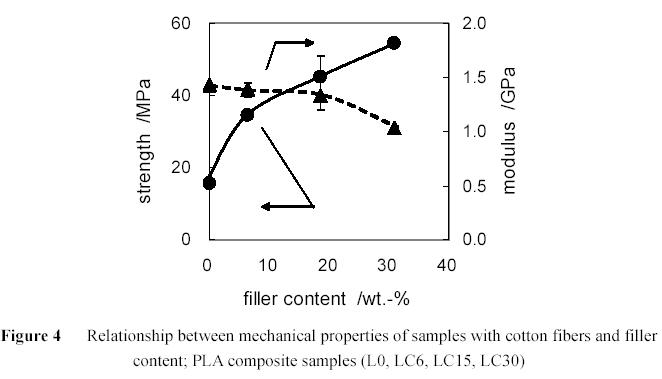
The mechanical properties of composite samples are shown in Figure 4. For PLA/CFC composite samples, two relationships between fiber content and strength and between fiber content and modulus are shown in Figure 4. The values of modulus decrease with increasing filler content. It is difficult for the manufacturing method in this study to remove air in the composites. The existence of air in composites also causes the decrease of modulus of samples. In contrast, the values of strength for both composite samples increase with increasing filler content. The fillers in composites prevent the breakage of samples, although PLA is brittle matrix. The almost same results for PLA/CFP composites as those for PLA/CFC samples were obtained. The modulus of composite samples is mainly determined by the modulus of PLA and a small decrease of modulus seems to be caused by a decrease of molecular weight of PLA in composites.
Conclusions
Poly(lactic acid) (PLA) composites filled with filter paper fibers or cotton fibers were manufactured by using aluminum triflate as a catalyst. The strength of the composite samples increases with increasing fiber content, although the elastic modulus and density of samples decrease with increasing fiber content. The biodegradability of samples is accelerated by the existence of fibers. PLA composite samples with higher strength and higher biodegradability can be obtained by combining PLA and cellulose fibers. The possibility of controlling mechanical properties and biodegradability of PLA composites by filling the cellulose fibers has been shown.
Reference
1. M. Kunioka, Y. Wang, S. Onozawa, Polym. J., 2003, 35, 422.
2. Y. Wang, S. Onozawa, M. Kunioka, Green Chem., 2003, 5, 571.
3. M. Funabashi, M. Kunioka Green Chem., 2003, 5, 591.
三氟甲基磺酸鋁催化制備聚乳酸纖維素纖維復(fù)合材料
通過我們最新方法制備了聚乳酸(PLA)纖維素纖維(CF)可生物降解聚合物復(fù)合材料。在簡單的塑料管中,以三氟甲基磺酸鋁為催化劑,丙三醇為引發(fā)劑,CF作為填充劑進行L-乳酸(LA)的開環(huán)聚合反應(yīng),于100°C下反應(yīng)6小時。通過這種方法CF可以很容易和均勻地與聚合物體系混合。凝膠滲透色譜(GPC)測定PLA的分子量和分子量分布表明復(fù)合物試樣的Mn隨CF含量的增加從6200降至2800。復(fù)合物分子量分布在2.5左右且不受CF含量的影響。復(fù)合物試樣的表觀密度通過計算柱形試樣的重量和大小得到。試樣的生物降解性研究采用微生物氧化降解分析(MODA)和堆肥失重測定。MODA測定表明,復(fù)合物試樣的生物降解性隨CF含量的增加而增加。復(fù)合物試樣的密度較不含有CF的純PLA略低。通過抗壓試驗研究了柱形試樣的彈性模量和強度等機械性能。結(jié)果表明對于有CF濾紙的試樣,復(fù)合物試樣的強度隨CF含量增加而增加。
論文來源:1st International Conference on Technology and Application of Biodegradable Polymers and Plastics,October,2004

